
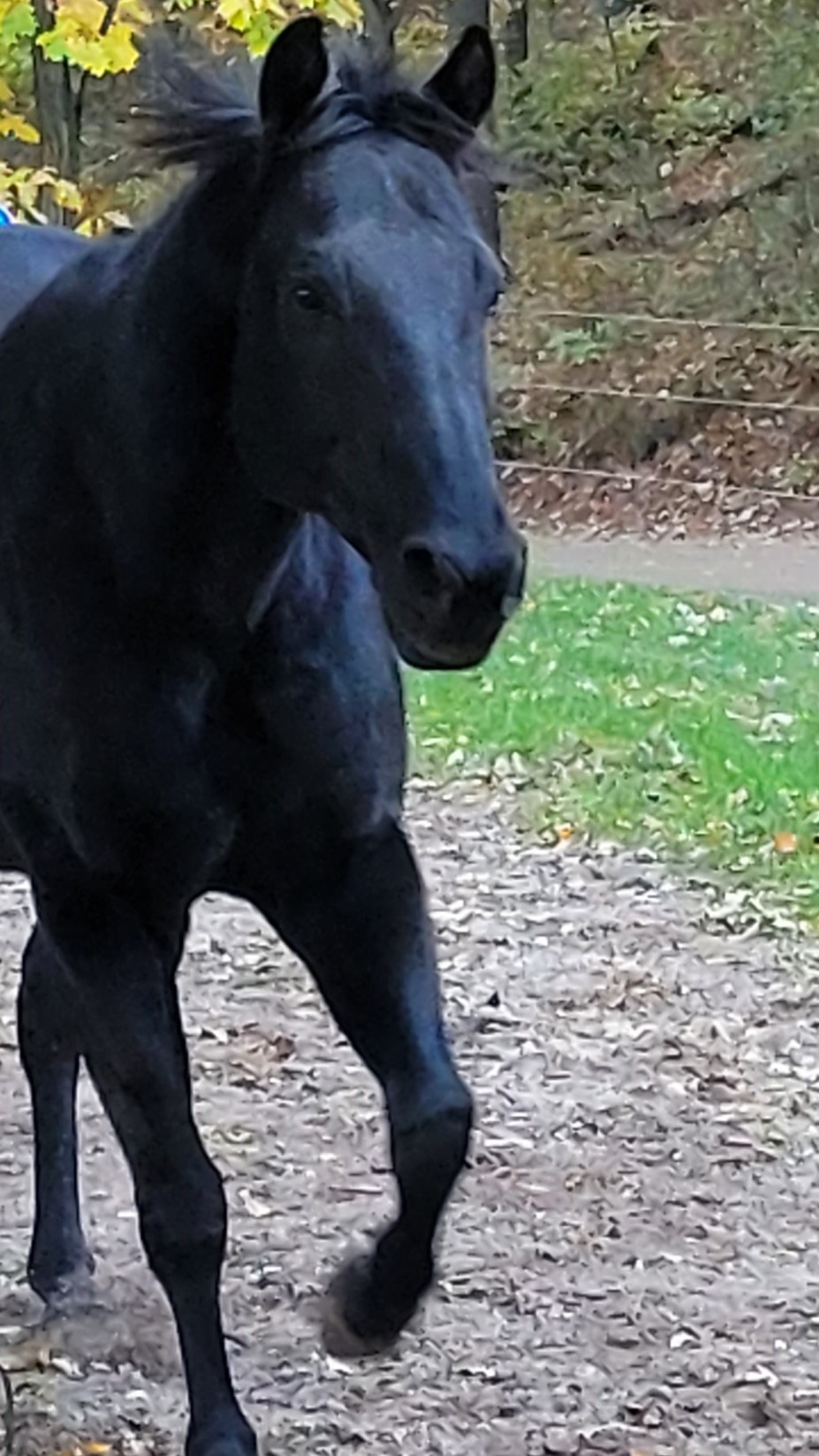
The Horse and I

“Let God have your life; he can do more with it than you can.” – Dwight L. Moody

I don’t know much about horses. But, here I was at a ranch for a weekend with my daughter and granddaughter. Because my granddaughter loves horses and wanted me to experience them, too, we all signed up for the trail ride. And I learned something.

We were shown how to use the reins and told not to let our horse get too close to the horse in front of him and not to let him eat foliage along the way. So, determined to do it right, we set out. I pulled on Cairo’s reins when he got too close to Hoss, and I steered him away from the plants along the trail. Eventually, though, he got tired of being micromanaged. He tossed his head and snorted a couple of times. He was not happy!

So, I decided to quit fighting him (he’s bigger than I am!), and I let the reins go slack. He settled into a pattern he was comfortable with, and we finished the ride better friends than we were when we started.

Are you a little bit like me? Wanting to hang on tight to the reins, to steer, to be in control? Sometimes, I think everyone around us would be better off if we stop trying so hard to be safe, right, and in charge. It would be good for us, too, just to realize that God is the only one who can change people or protect us.

And, best of all, when we yield to him, we can enjoy the ride!


“I do not occupy myself with things
    too great and too marvelous for me.
But I have calmed and quieted my soul,
    like a weaned child with its mother;”
– Psalm 131:1b-2a

Feeling loved?

“How would my life change if I truly believed the Bible’s astounding words about God’s love for me, if I looked in the mirror and saw what God sees?” – Philip Yancey

Do you remember the feeling of euphoria when you first fell in love?

I think being in love is a picture of what God feels about us every day. He loves us just as we are, not just on our good days, but every single day. He loved us before we were born and will never stop.

The prophet Daniel, a Judean captive serving the Babylonian king, was praying for his people, pleading for God act on their behalf. While he prayed, the angel Gabriel appeared telling Daniel he had come to give him insight into the things he was praying about. And he gave the reason: “. . . I have come to tell it to you, for you are greatly loved” (Daniel 9:23a). Can you imagine an angel saying to you that he showed up because you were greatly loved – by God?

Maybe we don’t hear it from an angel, but, if I’m reading my Bible correctly, we are as greatly loved as Daniel was. John tells how Jesus loved his disciples. Jesus declares his love for them, too, and for the whole world. Even before Jesus’ time, God said many times how much he loves his own people.

So why don’t we feel the “in love” euphoria every day? Maybe because we don’t really believe it. Think about that. The one who says he loves us is the eternal truth, the God who loved us into being. We can trust him. We can love him back. He will never turn us away. Never.

 “So we have come to know and to believe the love that God has for us.”. – 1 John 4:16a

Insight

“A moment of insight from God is worth a lifetime of experience.” – Anonymous

There’s a lot we cannot see with our eyes.

The story in the Bible that gives dramatic evidence of this is when the King of Syria sent a whole army to capture Elisha, and Elisha is calm, but his servant is terrified. So Elisha asks God to open his servant’s eyes so he can see what Elisha already knows: There are heavenly chariots of fire all around them! The servant had been afraid because he couldn’t see the protection God had already provided.

God can help us see the things we cannot see on our own. And praying for him to help us see is biblical, “Open my eyes that I may behold wonderful things out of your law” (Psalm 119:18).

Those might be insights to understand the messages in God’s Word, yes, but I have found there are more ways God helps us to see.

He can give insight . . .

. . . to sense when someone says they’re fine when they’re not.

. . . to clearly discern the direction we are to take.

. . . to know when to instruct and when to confront.

. . . to understand today’s events in light of eternity.

. . . to ‘see’ the heavenly help we receive when the battle seems overwhelming.

I believe God wants us to live in the light of his revelation every day. Commitment to constant walking with him allows us to see the things only he can reveal, and our decisions, understanding, and relationships take on new and richer dimensions. Open my eyes, Lord!

“. . . that the God of our Lord Jesus Christ, the Father of glory, may give you the Spirit of wisdom and of revelation in the knowledge of him, having the eyes of your hearts enlightened, that you may know what is the hope to which he has called you . . .” – Ephesians 1:17-18a

Old Friends

“Wishing to be friends is quick work, but friendship is a slow ripening fruit.” -Aristotle

I had a best friend in the 5th grade. She and I both liked to write – we wrote stories and poems (hers were better than mine!). We rode bikes, and we were involved together in kids clubs and, later, the youth group at our church. We had spiritual and philosophical conversations that grew in quality through the years.

We remained friends through high school, then our paths diverged (including moving from our hometown), as they often do, though we kept in touch somewhat through social media.

Recently we’ve had the opportunity to reconnect. We scheduled a time to meet and talked for two hours. That wasn’t enough, so we met a few days later and talked for 2 1/2 hours. So many parallel stories and a multitude of memories and revelations; so much common ground in our families – parents, children, grandchildren; our education and career experiences; and, best of all, our commitment to a step-by-step, year-by-year walk with God.

At some point we realized the value of what we had in each other. Growing a friendship takes time. Not just activity time, or conversation time, but years of time. We both have newer friends we value very much, but neither of us has the time to develop a half-century long friendship with another person.

Do you have a friend like that? Maybe it’s time to reconnect and to recognize the value in such a relationship.

Do you need a friend like that? Maybe you don’t have decades to build it, but use the time you have. Be a friend, find a friend. Spiritual friendship is one of the greatest gifts we can give or receive.

“As iron sharpens iron, so a friend sharpens a friend.” – Proverbs 27:17, (NLT)

Just ask.

Let your cares drive you to God. I shall not mind if you have many of them if each one leads you to prayer. If every fret makes you lean more on the Beloved, it will be a benefit.” – Charles Spurgeon

Do you find it hard to ask for help? A lot of us do. We want to think we can figure things out on our own, we can tackle any problem. And we don’t want to be a bother to anyone else.

That independent attitude might be admired by some, but not by God.

He wants us to express our needs to him. He wants us to look at every life situation as an invitation to turn to him. In fact, James tells us that sometimes he is just waiting for us to ask: “You do not have, because you do not ask” (James 4:2b). So, I have been asking, and he welcomes my requests every single time.

I’ve figured something else out, too. It has become clear to me that God uses our requests as ways to respond to us at the point of our deepest needs. Do we need patience? He might make us wait a while before he answers. Do we need humility? He might remind us to submit to his will. Do we need comfort? That’s the Holy Spirit’s specialty, and prayer opens our hearts to receive.

Do you understand? God’s greatest desire is to be connected to us, to provide for us, to comfort and lead us. Praying, asking, and just talking to him opens the doors for his love to flow back to us. Just ask. That’s the way he wants it.

Do not be anxious about anything, but in everything by prayer and supplication with thanksgiving let your requests be made known to God. Philippians 4:6

The Happiest Being in the Universe

“If you want to get warm you must stand near the fire: if you want to be wet you must get into the water. If you want joy, power, peace, eternal life, you must get close to, or even into, the thing that has them. – C. S. Lewis

Author John Ortberg tells us that “God is the happiest being in the universe.” Our joyful, creative, energetic, and passionate Father wants us to be happy, too.

In fact, joy is part of the Fruit of the Spirit described in Ephesians 5. When God uses agricultural images like fruit, I think he’s reminding us of what farmers already know: Growing anything takes patience. We sometimes want to hurry the process by using earthly pleasures to manufacture joy, but what we get then is a poor substitute for the real thing.

True joy grows over time. I think the Holy Spirit plants the seeds and then, with our cooperation, helps those seeds grow into full, ripe, abundant fruit.

What might our cooperation in growing this fruit look like? Here are three assessment questions that help me when I’ve lost my joy:

Who am I trying to please? If it’s another person or even people in general, we’ll be frustrated. If it’s God alone, we will experience his pleasure. And that makes us happy.

Is my focus on the temporary or the eternal? Having a long view helps us forego an immediate pleasure for a future reward. That brings peaceful confidence.

How close am I to the Happiest Being in the Universe? God’s effusive joy will overflow to us if we consciously engage with him all day long.

If our focus is on knowing and pleasing God more than anything else, joy will come. Guaranteed smiles.

“Shout for joy in the Lord, O you righteous.” Psalm 33:1

Getting Ready to Hear from God

“. . . in the liturgy from the past, I am reminded that wisdom from God has been around a long time. My words aren’t revolutionary. I can be helped by my brothers and sisters from the past. . . the words penetrate. They break away the hardness of my morning heart and get spiritual warmth pumping through my veins, showing once again it’s worth persevering in this liturgical pursuit, this routine.”* – Matthew Molesky

It’s a chilly morning. For the first time in weeks I reached for a sweatshirt before I sat in the chair with my Bible, pen, and fresh cup of coffee. Then, with my body warm and comfortable, I began to address my heart.

Do you, too, sometimes find you need to warm your heart before you’re ready to hear from God?

My heart gets ready when I read from the writings of Christians in ages past who had a longing to know God, feel his presence, and follow his direction. Some have written memoirs or left diaries or devotionals that give us windows into their hearts. The spiritual journeys of others can inspire our own desire to grow.

Here are a few of my favorites (would love to see yours in comments!):

Pursuit of God, A. W. Tozer

The Practice of the Presence of God, Brother Lawrence

The Normal Christian Life, Watchman Nee

Morning and Evening, Charles Spurgeon

My Utmost for His Highest, Oswald Chambers

After I read a short passage from one of these authors (or others like them), my heart is ready to turn to the Bible and to respond to its Spirit-guided message for today. The warm-up time is worth the effort!

Thus says the Lord: “Stand by the roads, and look, and ask for the ancient paths, where the good way is; and walk in it, and find rest for your souls.” – Jeremiah 6:16a

Some things take time.

Biblically, waiting is not just something we have to do until we get what we want. Waiting is part of the process of becoming what God wants us to be. – John Ortberg

David was anointed by God when he was young, tending his father’s sheep. He knew he would be king, but God had some preparation to do before that could happen.

David was brought into King Saul’s circle and, while there, became a popular public persona. Saul, though, was not impressed, and he planned ways to kill David – so much so, that David ran for his life.

It must have been frustrating moving from place to place, living sometimes in desert caves, always on the alert for Saul’s armies as they chased him. But what happened to David in these intervening years?

He grew up. He went from being a young boy to being a mature man.

He became strong. He fought many battles, growing in courage and confidence.

He learned to lead. There were 600 men who became his defenders. They were described as bitter, in-debt, and distressed. But they were loyal to David, and he led them to become more than they ever dreamed they could be – God’s ragtag army.

He became discerning. There were two times David did not take an opportunity to kill Saul. He knew there was a better way and was willing to wait for God’s plan. His actions show wisdom and spiritual understanding.

God didn’t waste the desert years in David’s life and he won’t waste yours either. If you are waiting for God’s next move, be patient. Know that he is using this time to prepare you for what is yet to come. Trust his grace.

“I wait for the Lord, my soul waits, and in his word I hope;” – Psalm 130:5

Planning Ahead

“Christ told his disciples not to be anxious about tomorrow, but he never said not to consider tomorrow. Intelligent problem solving demands careful consideration of the future effects of present solutions.” – R. C. Sproul

How are you at planning? Some personalities like to “wing it”, assuming everything will be OK. There may be times for just taking what comes and enjoying the ride. Most times, though, we need to plan. The book of Proverbs tells us that, and our Creator shows us this truth by example.

Paul says that God planned for our redemption before the world was created. He knew if he created beings with free will in a world where Satan could tempt, they would fall, and they would need a Redeemer. He foresaw it and planned for it before he said, “Let there be light.”

Most of us love this message to Israel that we claim, too: “For I know the plans I have for you,” declares the Lord, “plans for welfare and not for evil, to give you a future and a hope” (Jeremiah 29:11). There’s comfort and even awe in knowing God is planning ahead for each of us.

And he has a plan for how this world will end and the new eternal world will begin. The book of Revelation shows that plan in visions and pronouncements. It’s a hard book to figure out, but we do know God’s plan will unfold exactly as he envisions it.

We have responsibilities and dreams that will never be fulfilled if we don’t plan carefully. What is it for you today? Financial security? Emotional healing? Healthy relationships? Intimacy with God?

Yes, we live by faith, but our faith must be accompanied by some God-guided planning!

“The heart of man plans his way, but the Lord establishes his steps.” – Proverbs 16:9

The Gift of Hope

“I claim the gift of hope. I have hope, not in the glorious achievements of man, but in the ever-glorious providence of God.” – Dwight Longenecker

I like to pride myself in being an optimist – you know the “glass half-full” kind of person. You, too? Optimists are surely more fun to be around than pessimists!

But in a world full of problems that seem unsolvable, optimism falls short. It usually is unrealistic and is ineffective in addressing the challenges of life. Instead, I suggest we turn to hope. Not the weak, “I hope so” kind, but a strong biblical hope based solely on the providence of our almighty, all-loving God. It’s a hope that is an assurance God will act, good will come, and justice will prevail, even though we may have to wait for its complete fulfillment. If our hope is based on biblical promises, what we hope for is as real as the ground we walk on.

In 1 Corinthians 13, Paul assigns hope with faith and love as the three main values that endure. Why, I wonder? I think because faith is needed to access hope. When we learn to trust God’s promises and his character, we will be filled with hope. With that in place, what can we do but love him and love others? Godly hope energizes love because we know we are and will be taken care of – there is enough of God’s provision for everyone. Hopeful people are loving people.

Once we get a taste of that kind of hope, we realize the shallowness of mere optimism. Hope based on God’s providence is not optimism. It’s reality.

“And hope does not put us to shame, because God’s love has been poured out into our hearts through the Holy Spirit, who has been given to us.” – Romans 5:5